
Windows Neuromorphic Co-Design Workspace
For device experiments, synapses, crossbars, SNNs, hardware metrics, variation/noise, Pareto optimization and the Engineering Agent.
NEUROMORPHIC HARDWARE · WINDOWS
From measured device data to synapses, crossbars, SNNs and system-level trade-offs
Place measured neuromorphic-device data and architecture analysis in one explainable workflow: fit the device, map it to synapses/crossbars/SNNs, then inspect latency, energy, throughput, area, variation and Pareto trade-offs.
PLATFORMS
Each platform is designed for a different workflow: desktop for deeper engineering analysis and mobile for portable calculations and quick checks.
For device experiments, synapses, crossbars, SNNs, hardware metrics, variation/noise, Pareto optimization and the Engineering Agent.
CAPABILITIES
The previous recording already covers the full path from device data to design trade-offs, so this page uses those real screens and results without requiring a new recording.
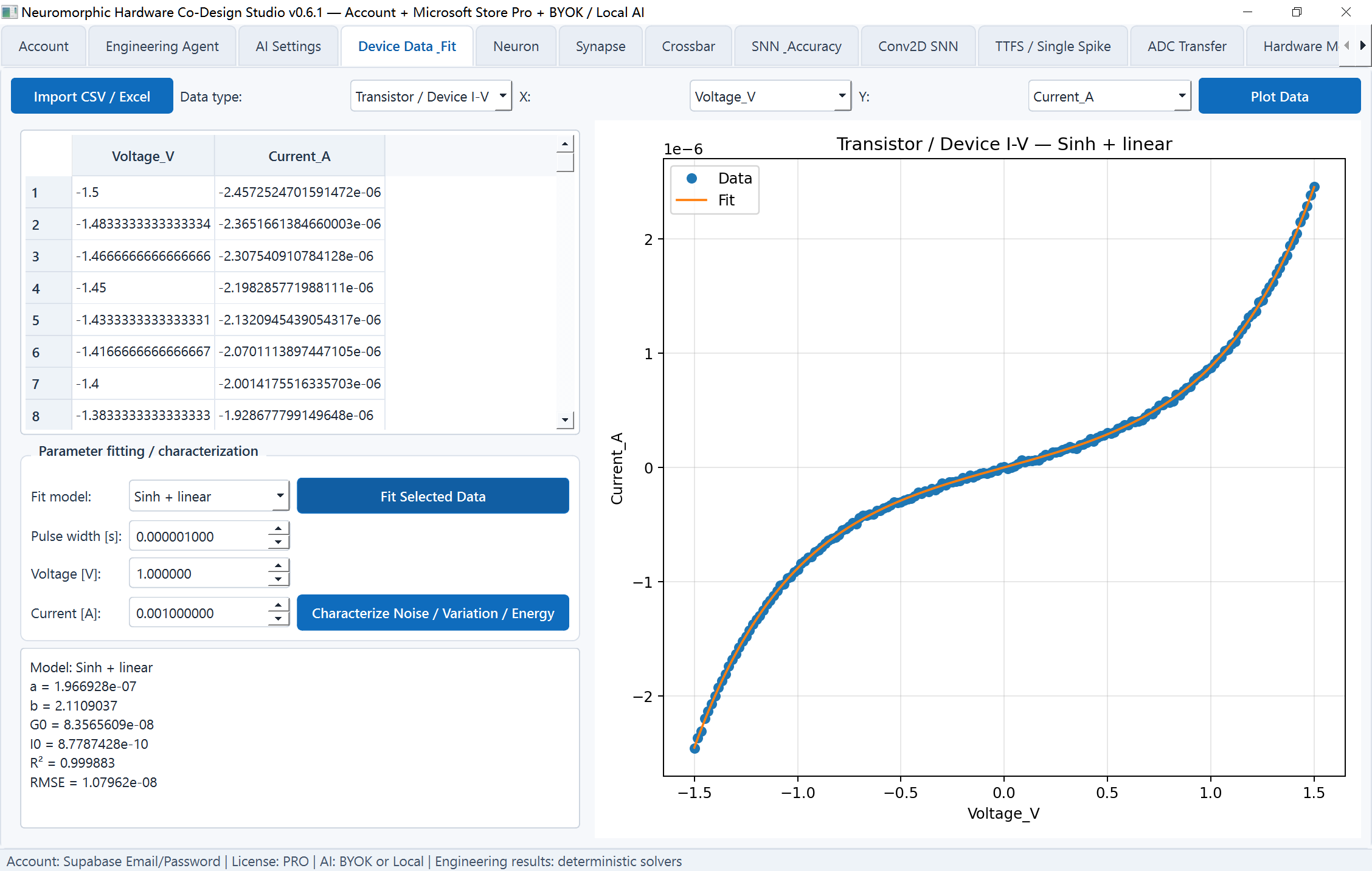
Import I-V, conductance, pulse, retention and endurance data, fit device models and inspect residuals.
Map conductance to synaptic weights and compare ideal/non-ideal VMM with quantization, resistance and device noise.
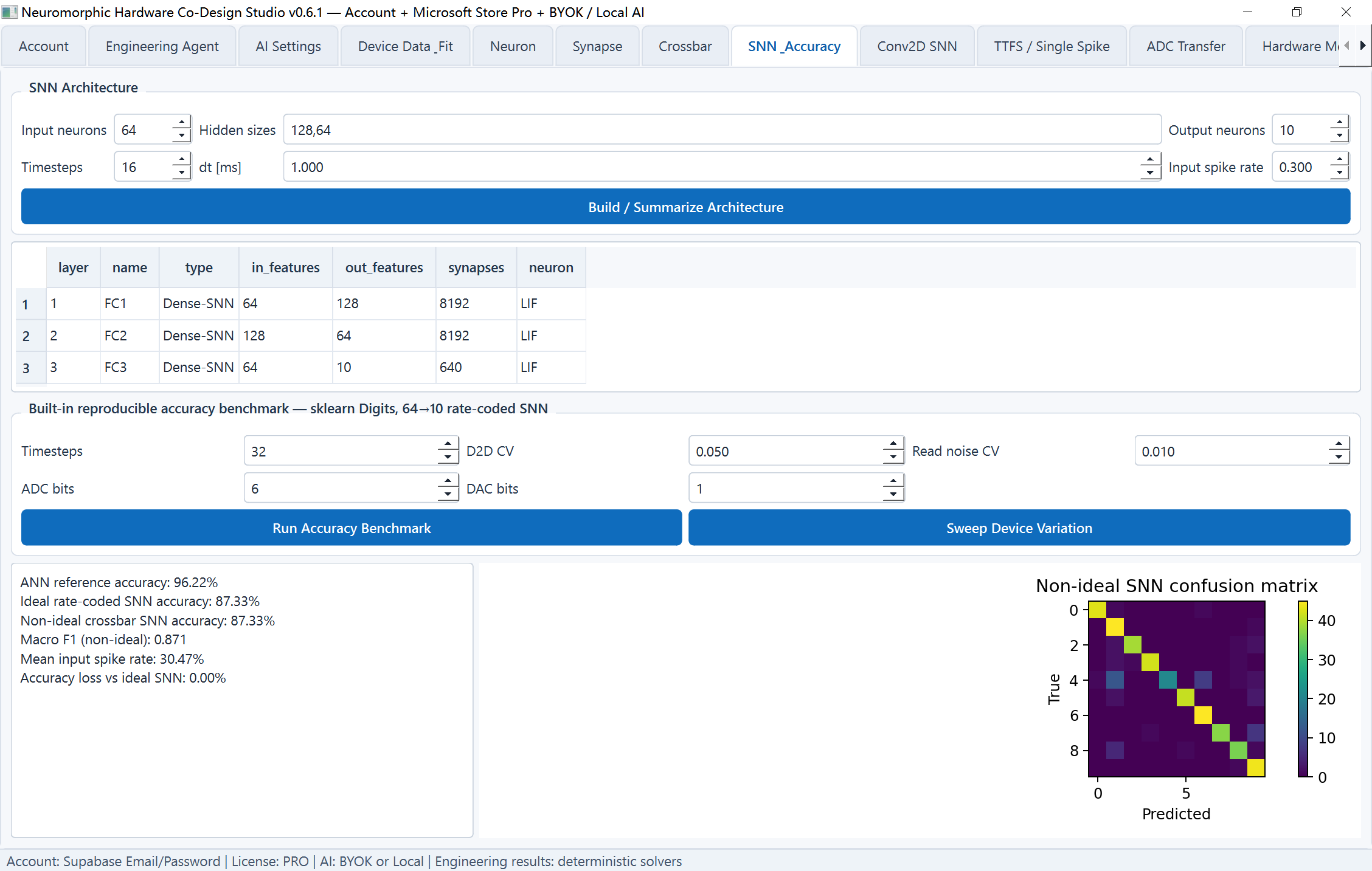
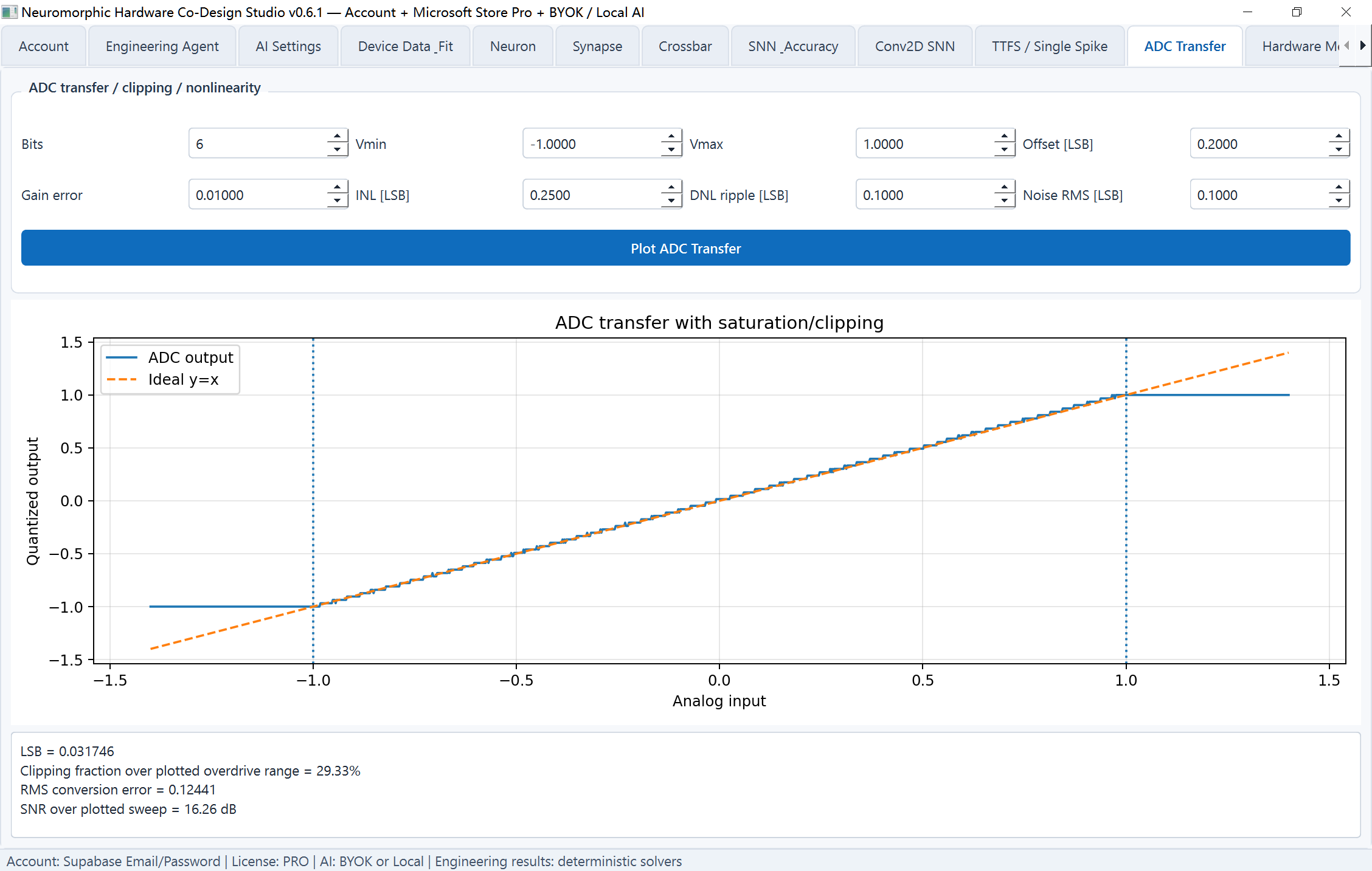
SNN/Conv2D, rate coding, TTFS, ADC/DAC transfer and clipping/error analysis.
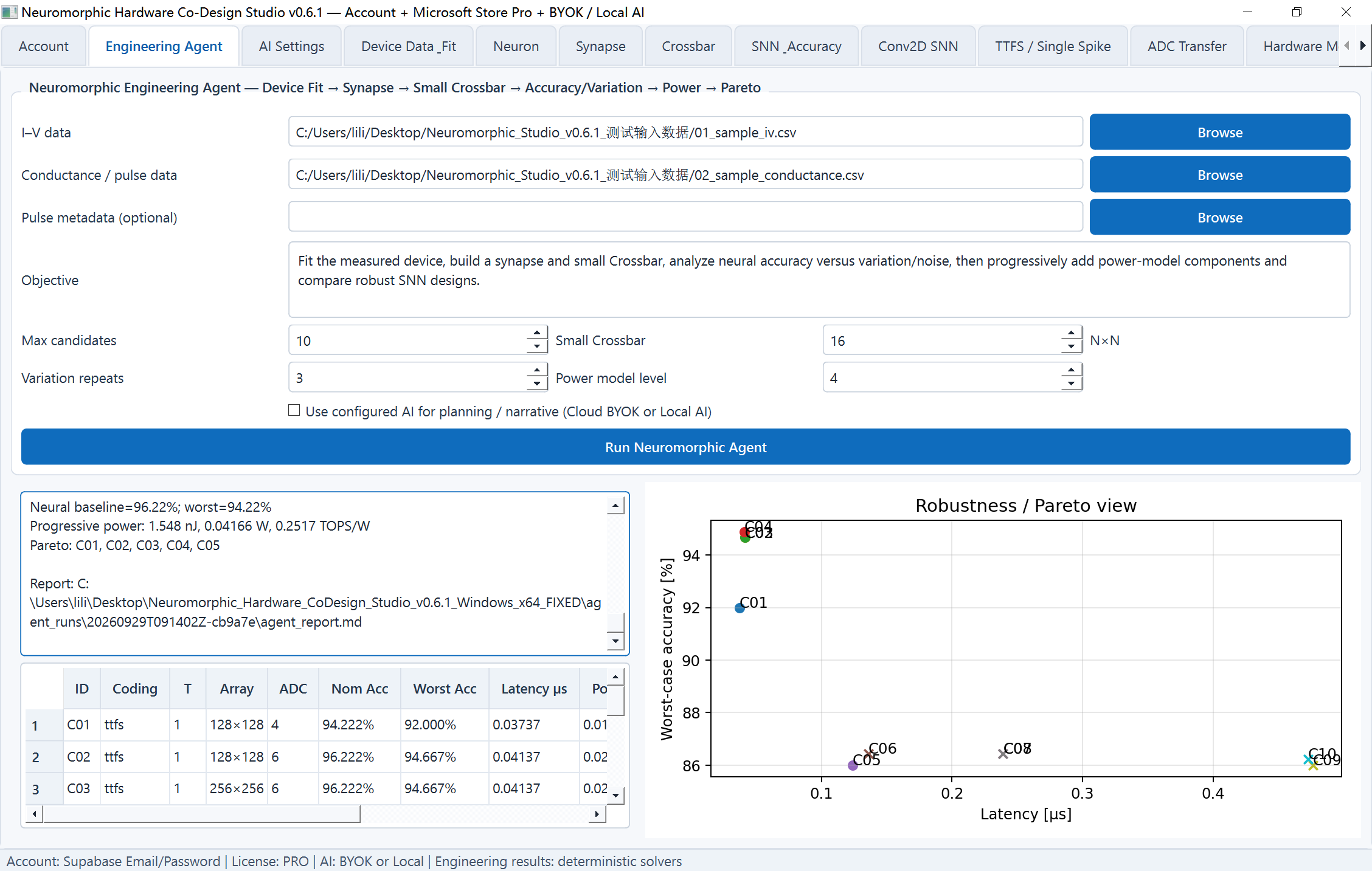
Latency, energy, throughput, area, TOPS/W, variation/noise, Pareto analysis and an optional Engineering Agent.
RESULTS & WORKFLOWS
These are real application screens from the previous test workflow: device I-V, SNN architecture, ADC transfer and Pareto/robustness results.
PRODUCT POSITIONING
For neuromorphic devices, compute-in-memory, SNN and hardware co-design research. Hardware metrics are engineering estimates under the configured analytical models and should be used alongside real device/chip measurements and independent validation.